Bible Study Guide Sample —
Exploring Ezra: Return, Rebuild, Restore
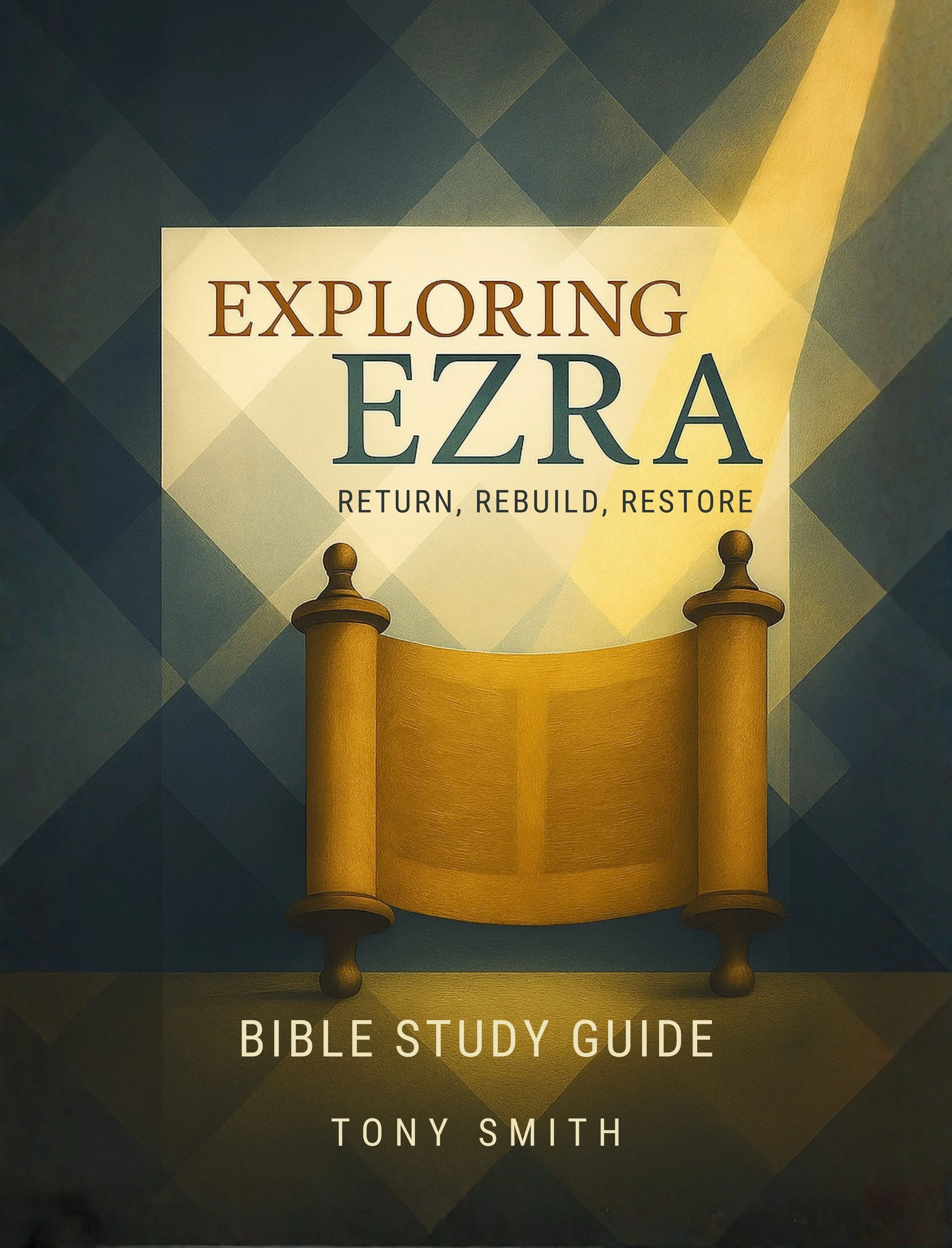
Exploring Ezra is a 10-lesson study guide through the book of Ezra.
Read lesson one below.
Ezra is a book about people who returned from exile, rebuilt what was broken, and rediscovered the Word of God. It is also a book for anyone who has ever needed a reset.
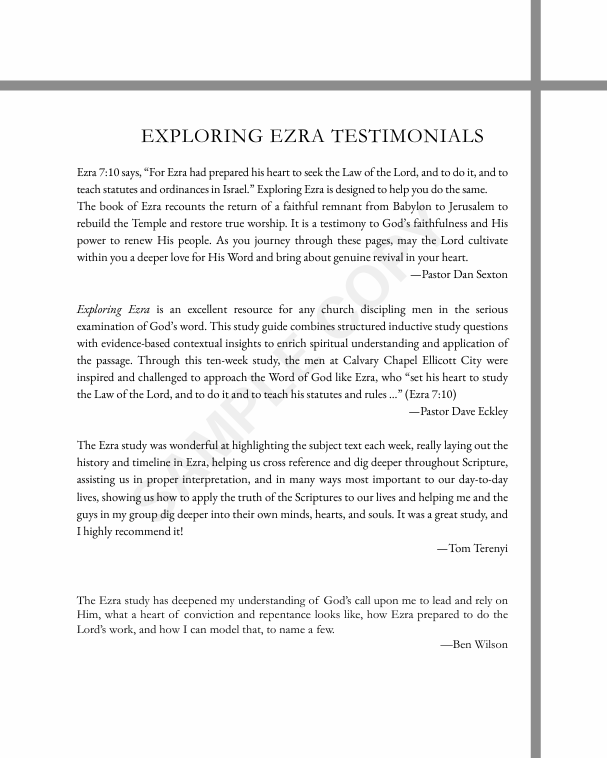
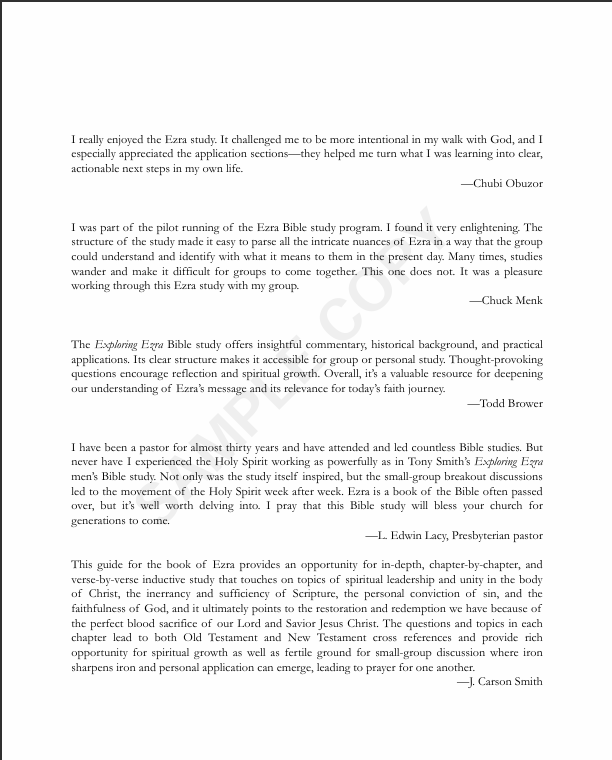
This 10-lesson printed study guide walks through the book of Ezra chapter by chapter — verse by verse, question by question — with historical background, cross-references, and application that connects the ancient text to life today.
Browse the printed workbook below and see for yourself.
Free Sample Bible Study Lesson: Exploring Ezra




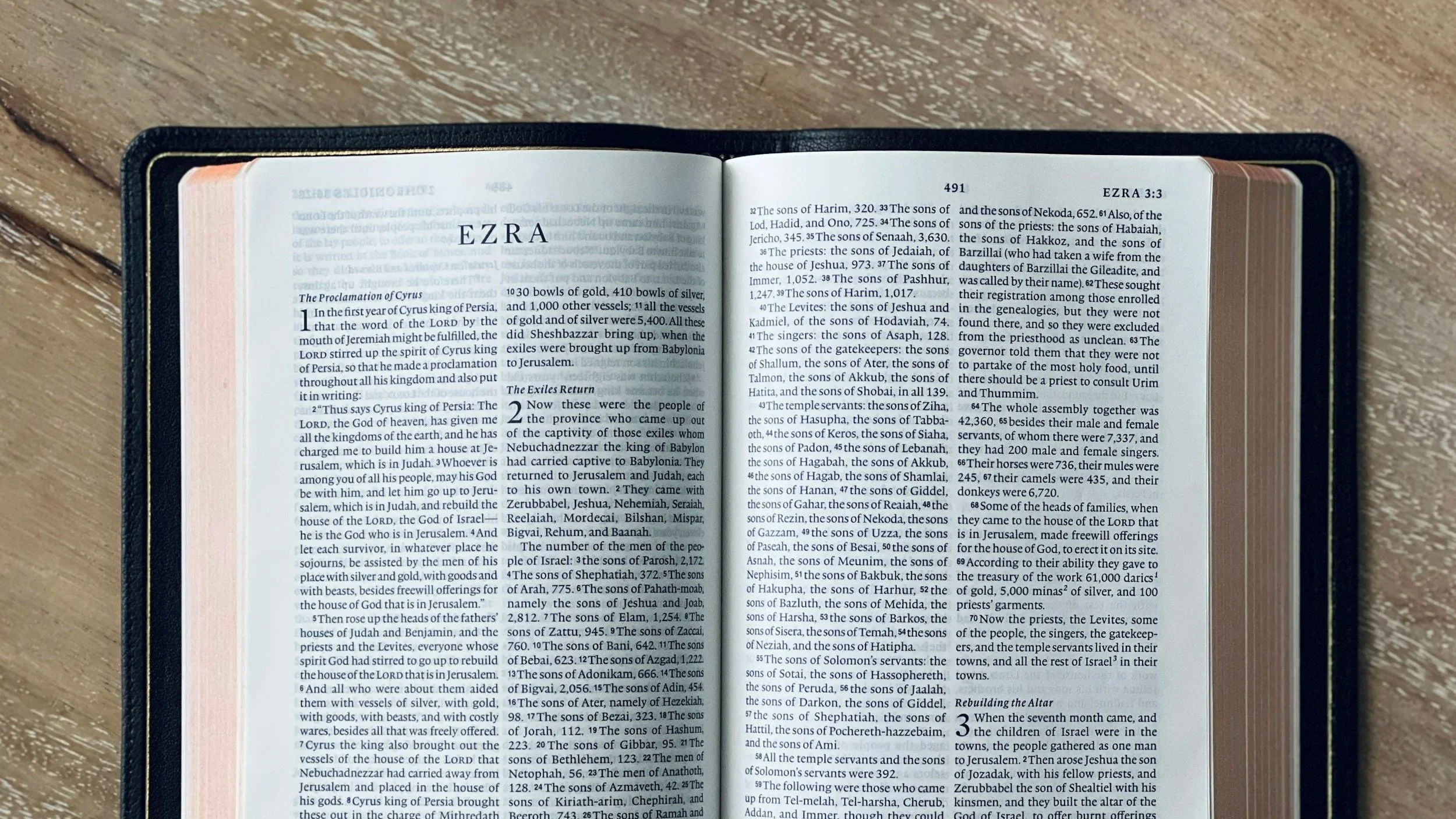
Ready to order your copy of Exploring Ezra?
Introduction
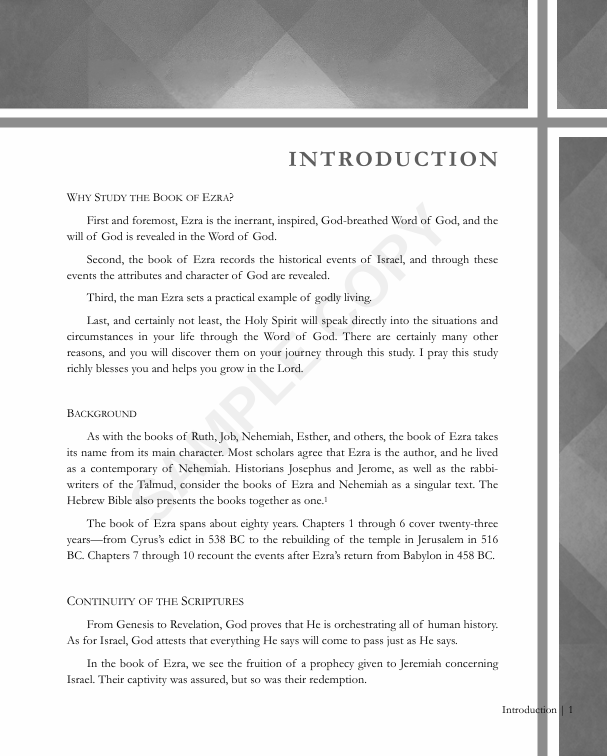
Why Study the Book of Ezra?
First and foremost, Ezra is the inerrant, inspired, God-breathed Word of God, and the will of God is revealed in the Word of God.
Second, the book of Ezra records the historical events of Israel, and through these events the attributes and character of God are revealed.
Third, the man Ezra sets a practical example of godly living.
Last, and certainly not least, the Holy Spirit will speak directly into the situations and circumstances in your life through the Word of God. There are certainly many other reasons, and you will discover them on your journey through completion of this study. I pray this study richly blesses you and helps you grow in the Lord.
Background
As with the books of Ruth, Job, Nehemiah, Esther, and others, the book of Ezra takes its name from its main character. Most scholars agree that Ezra is the author, and he lived as a contemporary of Nehemiah. Historians Josephus and Jerome, as well as the rabbi-writers of the Talmud, consider the Books of Ezra and Nehemiah as a singular text. The Hebrew Bible also presents the books together as one.1
The book of Ezra spans about eighty years. Chapters one through six cover twenty-three years—from Cyrus’s edict in 538 BC to the rebuilding of the temple in Jerusalem in 516 BC. Chapters seven through ten recount the events after Ezra’s return from Babylon in 458 BC.
Continuity of the Scriptures
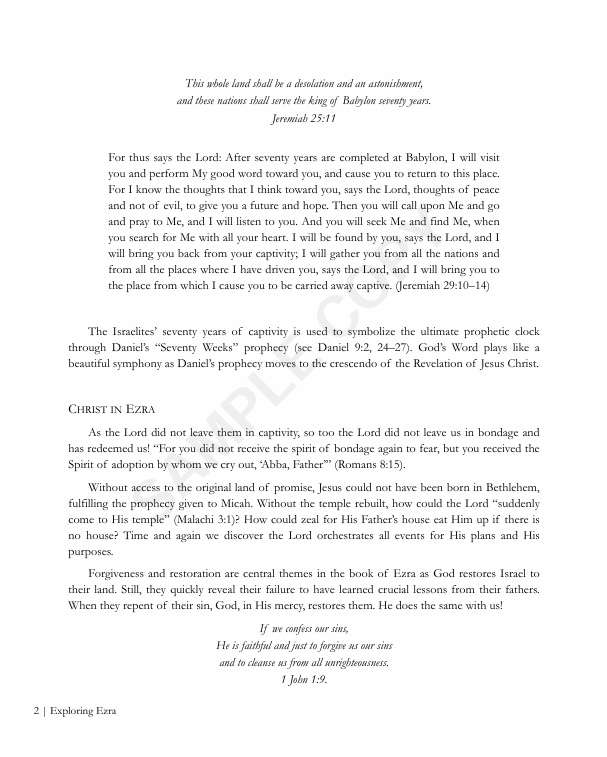
From Genesis to Revelation, God proves that He is orchestrating all human history. As for Israel, God attests that everything He says will come to pass just as He says. “And this whole land shall be a desolation and an astonishment, and these nations shall serve the king of Babylon seventy years” (Jeremiah 25:11).
In the book of Ezra, we see the fruition of a prophecy given to Jeremiah concerning Israel. Their captivity was assured, but so was their redemption.
For thus says the LORD: After seventy years are completed at Babylon, I will visit you and perform My good word toward you and cause you to return to this place. For I know the thoughts that I think toward you, says the LORD, thoughts of peace and not of evil, to give you a future and hope. Then you will call upon Me and go and pray to Me, and I will listen to you. And you will seek Me and find Me, when you search for Me with all your heart. I will be found by you, says the LORD, and I will bring you back from your captivity; I will gather you from all the nations and from all the places where I have driven you, says the LORD, and I will bring you to the place from which I cause you to be carried away captive. (Jeremiah 29:10–14)
The Israelites’ seventy years of captivity is used to symbolize the ultimate prophetic clock through Daniel’s “Seventy Weeks” prophecy (see Daniel 9:2, 24–27). God’s Word plays like a beautiful symphony as Daniel’s prophecy moves to the crescendo of the Revelation of Jesus Christ.
Christ in Ezra
As the Lord did not leave them in captivity, so too the Lord did not leave us in bondage and has redeemed us! “For you did not receive the spirit of bondage again to fear, but you received the Spirit of adoption by whom we cry out, ‘Abba, Father’” (Romans 8:15).
Without access to the original land of promise, Jesus could not have been born in Bethlehem, fulfilling the prophecy given to Micah. Without the temple rebuilt, how could the Lord “suddenly come to His temple?” How could zeal for His Father’s house eat Him up if there is no house? Time and again we discover the Lord orchestrates all events for His plans and His purposes.
Forgiveness and restoration are central themes in the book of Ezra as God restores Israel to their land. Still, they quickly reveal their failure to have learned crucial lessons from their fathers. When they repent of their sin, God, in His mercy, restores them. He does the same with us!
“If we confess our sins, He is faithful and just to forgive us our sins and to cleanse us from all unrighteousness” (1 John 1:9).
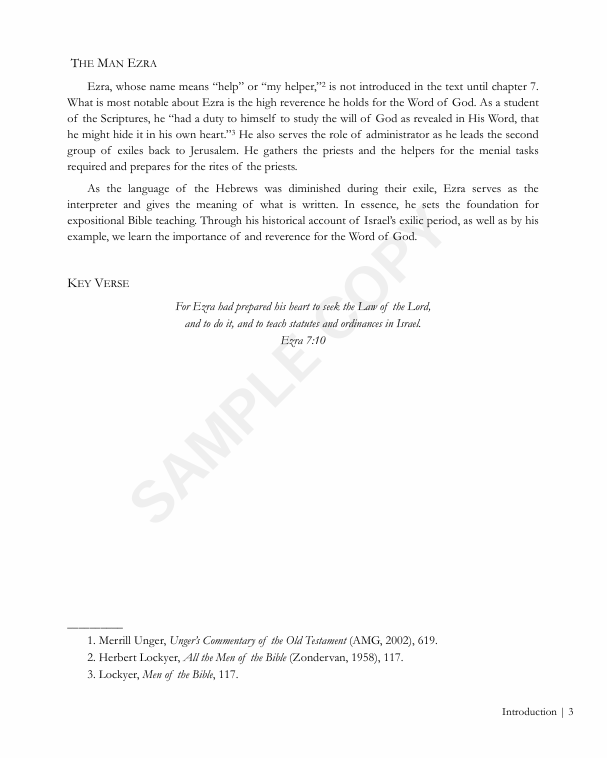
The Man Ezra
Ezra, whose name means “help” or “my helper,”2 is not introduced in the text until chapter seven. What is most notable about Ezra is the high reverence he holds for the Word of God. As a student of the Scriptures, he “had a duty to himself to study the will of God as revealed in His word, that he might hide it in his own heart.”3 He also serves the role of administrator as he leads the second group of exiles back to Jerusalem. He gathers the priests and the helpers for the menial tasks required and prepares for the rites of the priests.
As the language of the Hebrews was diminished during their exile, Ezra serves as the interpreter and gives the meaning of what is written. In essence, he sets the foundation for expositional Bible teaching. Through his historical account of Israel’s exilic period, as well as by his example, we learn the importance and reverence for the Word of God.
Key Verse
“For Ezra had prepared his heart to seek the Law of the Lord, and to do it, and to teach statutes and ordinances in Israel” (Ezra 7:10).
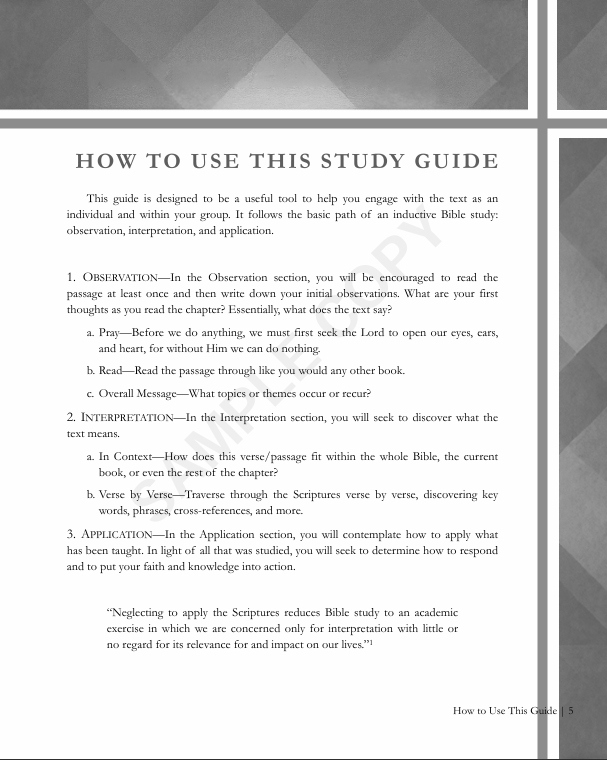
How to Use This Study Guide
This guide is designed to be a useful tool to help you engage with the text as an individual and within your group. It follows the basic path of an inductive Bible study: observation, interpretation, and application.
1. Observation — In the Observation section, you will be encouraged to read the passage at least once and then write down your initial observations. What are your first thoughts as you read the chapter? Essentially, what does the text say?
• Pray — Before we do anything, we must first seek the Lord to open our eyes, ears, and heart, for without Him we can do nothing.
• Read — Read the passage through like you would any other book.
• Overall Message — What topics or themes occur or recur?
1. Interpretation — In the Interpretation section, you will seek to discover what the text means.
• In Context — How does this verse/passage fit within the whole Bible, the current book, or even the rest of the chapter?
• Verse by Verse — Traverse through the Scriptures verse by verse, discovering key words, phrases, cross-references, and more.
1. Application — In the Application section, you will contemplate how to apply what has been taught. In light of all that was studied, you will seek to determine how to respond and to put your faith and knowledge into action.
“Neglecting to apply the Scriptures reduces Bible study to an academic exercise in which we are concerned only for interpretation with little or no regard for its relevance for and impact on our lives.”4
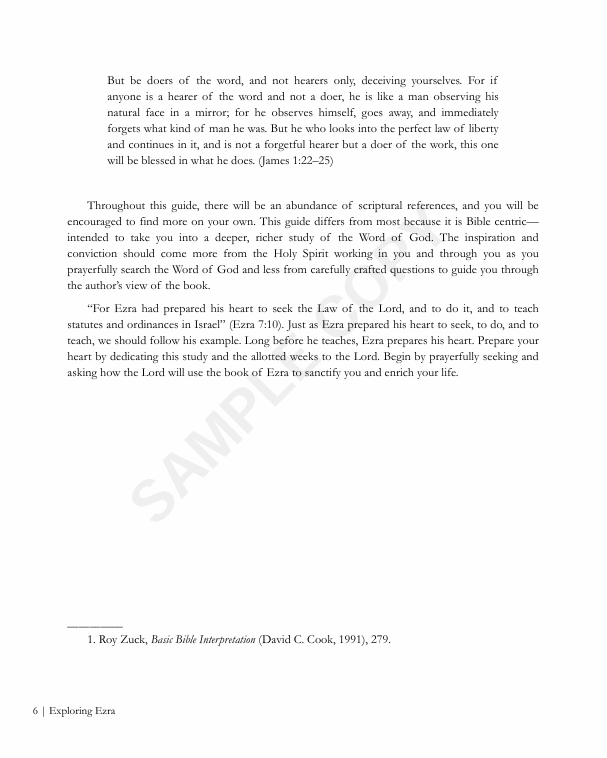
But be doers of the word, and not hearers only, deceiving yourselves. For if anyone is a hearer of the word and not a doer, he is like a man observing his natural face in a mirror; for he observes himself, goes away, and immediately forgets what kind of man he was. But he who looks into the perfect law of liberty and continues in it, and is not a forgetful hearer but a doer of the work, this one will be blessed in what he does. (James 1:22–25)
Throughout this guide, there will be an abundance of scriptural references, and you will be encouraged to find more on your own. This guide differs from most because it is Bible centric—intended to take you into a deeper, richer study of the Word of God. The inspiration and conviction should come more from the Holy Spirit working in you and through you as you prayerfully search the Word of God, and less from carefully crafted questions to guide you through the author’s view of the book.
“For Ezra had prepared his heart to seek the Law of the LORD, and to do it, and to teach statutes and ordinances in Israel” (Ezra 7:10). Just as Ezra prepared his heart to seek, to do, and to teach, we should follow his example. Long before he teaches, Ezra prepares his heart. Prepare your heart by dedicating this study and the allotted weeks to the Lord. Begin by prayerfully seeking and asking how the Lord will use the book of Ezra to sanctify you and enrich your life.
References
1 Merrill Unger, Unger’s Commentary on the Old Testament (AMG, 2002), 619.
2 Herbert Lockyer, All the Men of the Bible (Zondervan, 1958), 117.
3 Lockyer, All the Men of the Bible, 117.
4 Roy Zuck, Basic Bible Interpretation (David C. Cook, 1991), 279.
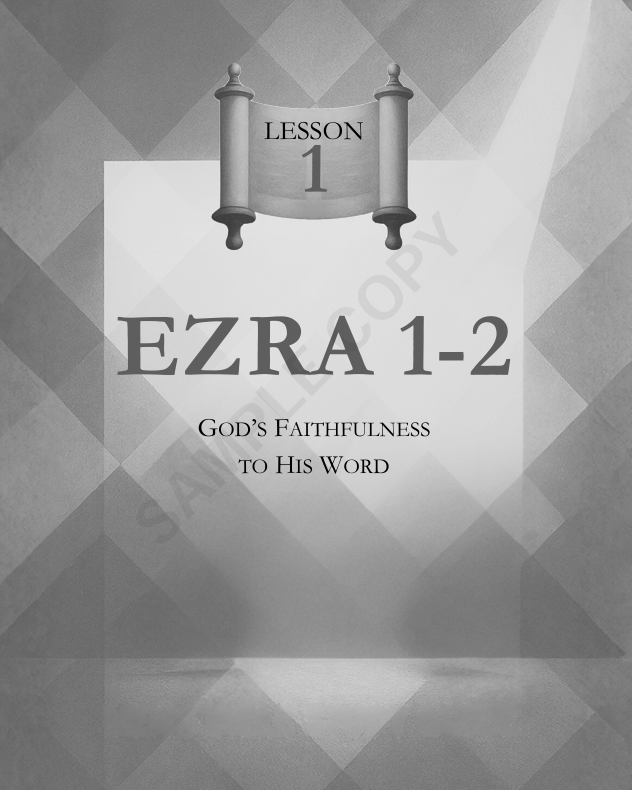
Ezra 1–2 — God’s Faithfulness to His Word
Key Verse
“Thus says Cyrus king of Persia: All the kingdoms of the earth the LORD God of heaven has given me. And He has commanded me to build Him a house at Jerusalem which is in Judah” (Ezra 1:2).
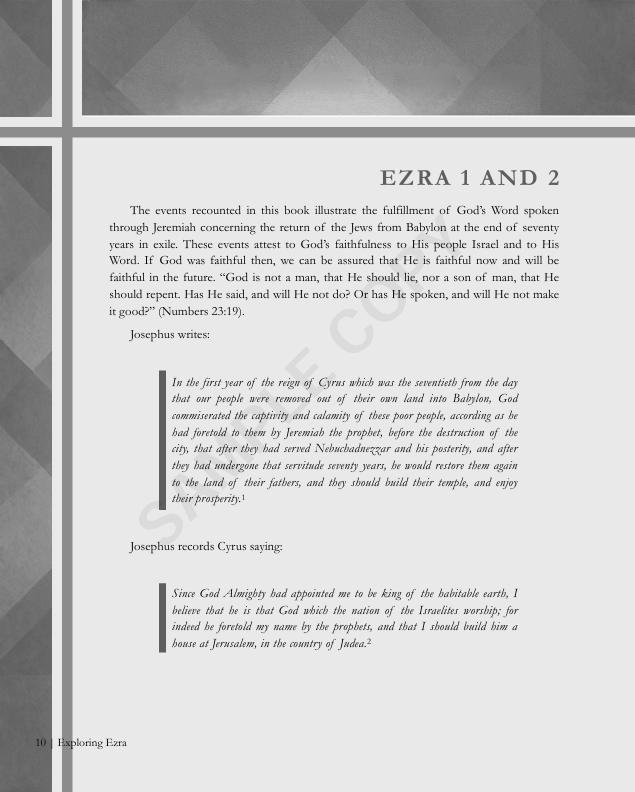
The events recounted in this book illustrate the fulfillment of God’s Word spoken through Jeremiah concerning the return of the Jews from Babylon at the end of seventy years in exile. These events attest to God’s faithfulness to His people Israel and to His Word. If God was faithful then, we can be assured that He is faithful now and will be faithful in the future. “God is not a man, that He should lie, nor a son of man, that He should repent. Has He said, and will He not do? Or has He spoken, and will He not make it good?” (Numbers 23:19).
Josephus writes:
In the first year of the reign of Cyrus which was the seventieth from the day that our people were removed out of their own land into Babylon, God commiserated the captivity and calamity of these poor people, according as he had foretold to them by Jeremiah the prophet, before the destruction of the city, that after they had served Nebuchadnezzar and his posterity, and after they had undergone that servitude seventy years, he would restore them again to the land of their fathers, and they should build their temple, and enjoy their prosperity.¹
Josephus records Cyrus saying:
Since God Almighty had appointed me to be king of the habitable earth, I believe that he is that God which the nation of the Israelites worship; for indeed he foretold my name by the prophets, and that I should build him a house at Jerusalem, in the country of Judea. This was known to Cyrus by his reading the book which Isaiah left behind him of his prophecies …²
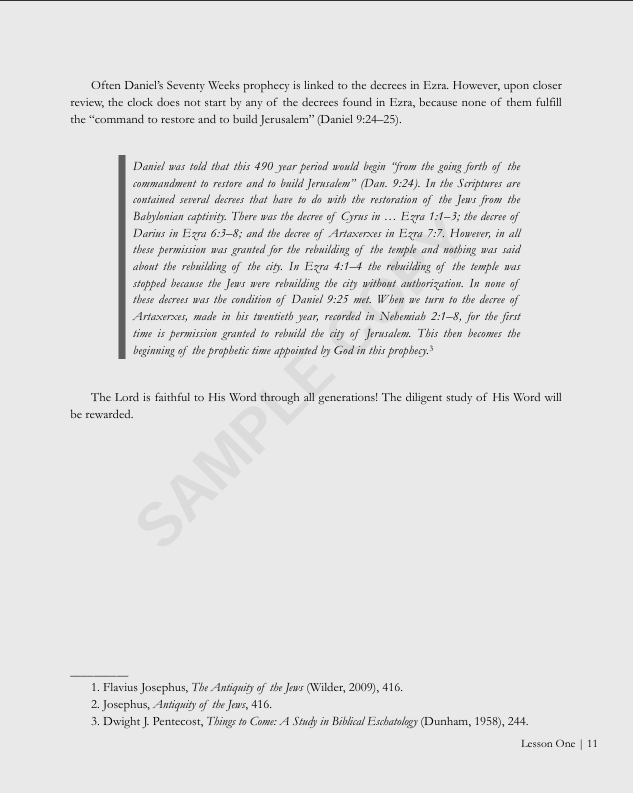
Often Daniel’s Seventy Weeks prophecy is linked to the decrees in Ezra. However, upon closer review, the clock does not start by any of the decrees found in Ezra, because none of them fulfill the “command to restore and to build Jerusalem” (Daniel 9:24–25).
Daniel was told that this 490-year period would begin “from the going forth of the commandment to restore Jerusalem” (Daniel 9:24). In the Scriptures are contained several decrees that have to do with the restoration of the Jews from the Babylonian captivity. There was the decree of Cyrus (Ezra 1:1–3); the decree of Darius in Ezra 6:3–8; and the decree of Artaxerxes in Ezra 7:7. However, in all these, permission was granted for the rebuilding of the temple, and nothing was said about the rebuilding of the city. In Ezra 4:1–4 the rebuilding of the temple was stopped because the Jews were rebuilding the city without authorization. In none of these decrees was the condition of Daniel 9:25 met. When we turn to the decree of Artaxerxes, made in his twentieth year, recorded in Nehemiah 2:1–8, for the first time is permission granted to rebuild the city of Jerusalem. This then becomes the beginning of the prophetic time appointed by God in this prophecy.³
The Lord is faithful to His Word through all generations! The diligent study of His Word will be rewarded.
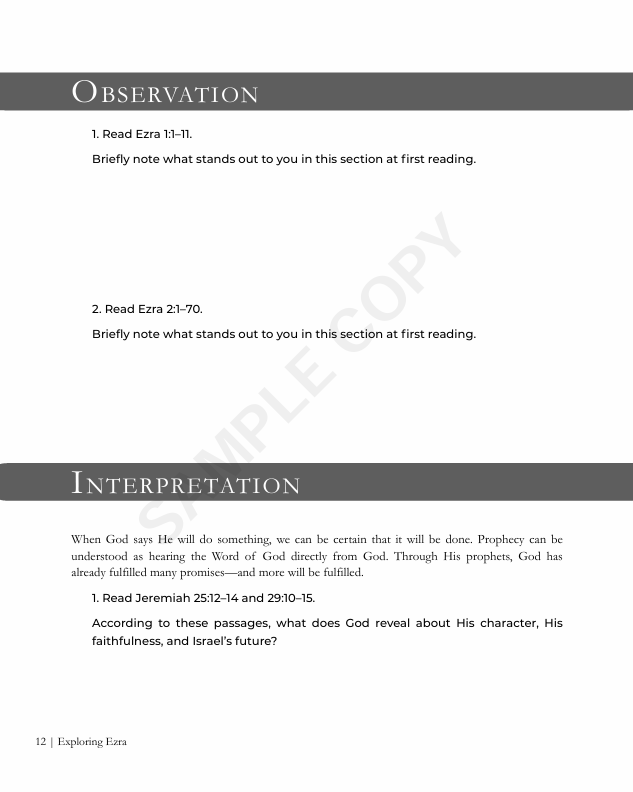
Observation
1. Read Ezra 1:1–11. Briefly note what stands out to you in this section at first reading.
2. Read Ezra 2:1–70. Briefly note what stands out to you in this section at first reading.
Interpretation
1. When God says He will do something, we can be certain that it will be done. Prophecy can be understood as hearing the Word of God directly from God. Through His prophets, God has already fulfilled many promises—and more will be fulfilled.
Read Jeremiah 25:12–14 and 29:10–15.
According to these passages, what does God reveal about His character, His faithfulness, and Israel’s future?
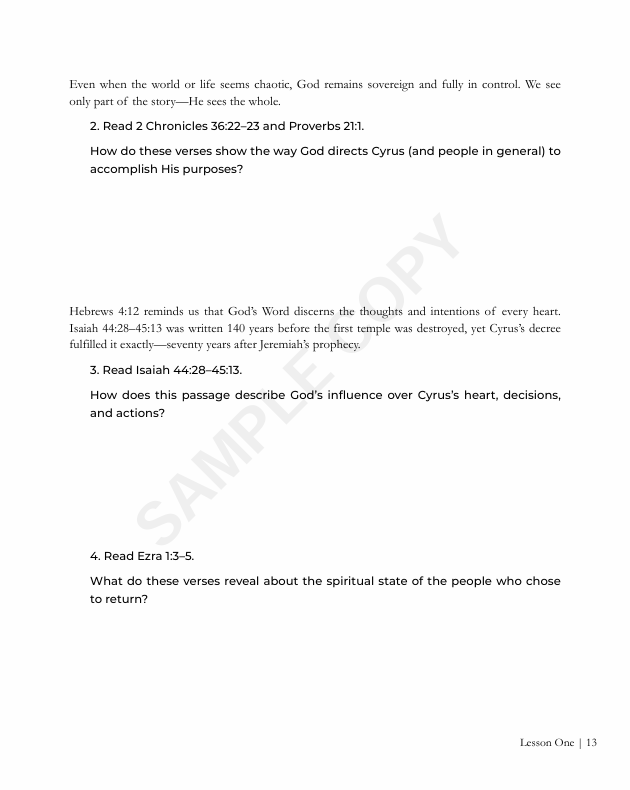
2. Even when the world or life seems chaotic, God remains sovereign and fully in control. We see only part of the story—He sees the whole.
Read 2 Chronicles 36:22–23 and Proverbs 21:1.
How do these verses show the way God directs Cyrus (and people in general) to accomplish His purposes?
3. Hebrews 4:12 reminds us that God’s Word discerns the thoughts and intentions of every heart. Isaiah 44:28–45:13 was written 140 years before the first temple was destroyed, yet Cyrus’s decree fulfilled it exactly—seventy years after Jeremiah’s prophecy.
Read Isaiah 44:28–45:13. How does this passage describe God’s influence over Cyrus’s heart, decisions, and actions?
4. Read Ezra 1:3–5.
What do these verses reveal about the spiritual state of the people who chose to return?
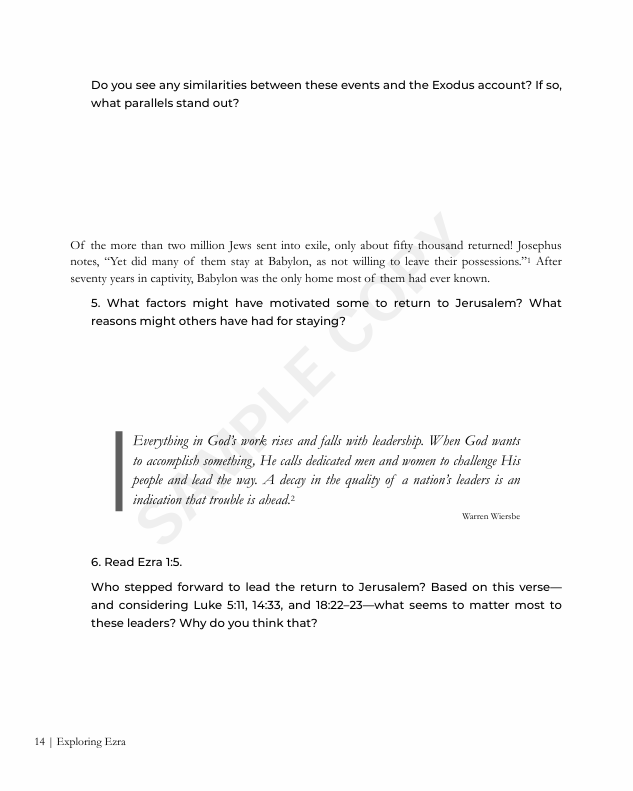
Do you see any similarities between these events and the Exodus account? If so, what parallels stand out?
5. Of the more than two million Jews sent into exile, only about 50,000 returned! Josephus notes, “Yet did many of them stay at Babylon, as not willing to leave their possessions.”4 After seventy years in captivity, Babylon was the only home most of them had ever known.
What factors might have motivated some to return to Jerusalem? What reasons might others have had for staying?
“Everything in God’s work rises and falls with leadership. When God wants to accomplish something, He calls dedicated men and women to challenge His people and lead the way. A decay in the quality of a nation’s leaders is an indication that trouble is ahead.”⁵
6. Read Ezra 1:5. Who stepped forward to lead the return to Jerusalem? Based on this verse—and considering Luke 5:11, 14:33, and 18:22–23—what seems to matter most to these leaders? Why do you think that?
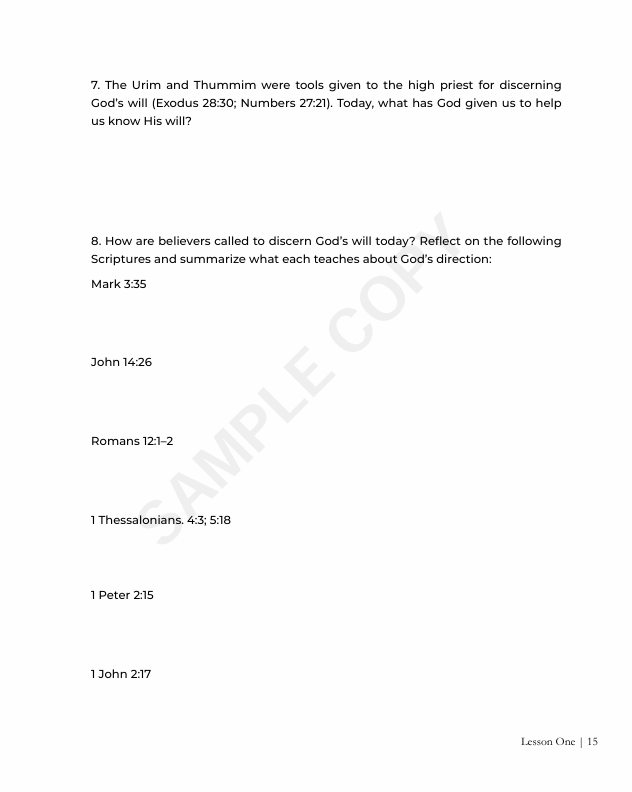
7. The Urim and Thummim were tools given to the high priest for discerning God’s will (Exodus 28:30; Numbers 27:21). Today, what has God given us to help us know His will?
8. How are believers called to discern God’s will today? Reflect on the following Scriptures and summarize what each teaches about God’s direction:
Mark 3:35
John 14:26
Romans 12:1–2
1 Thessalonians 4:3; 5:18
1 Peter 2:15
1 John 2:17
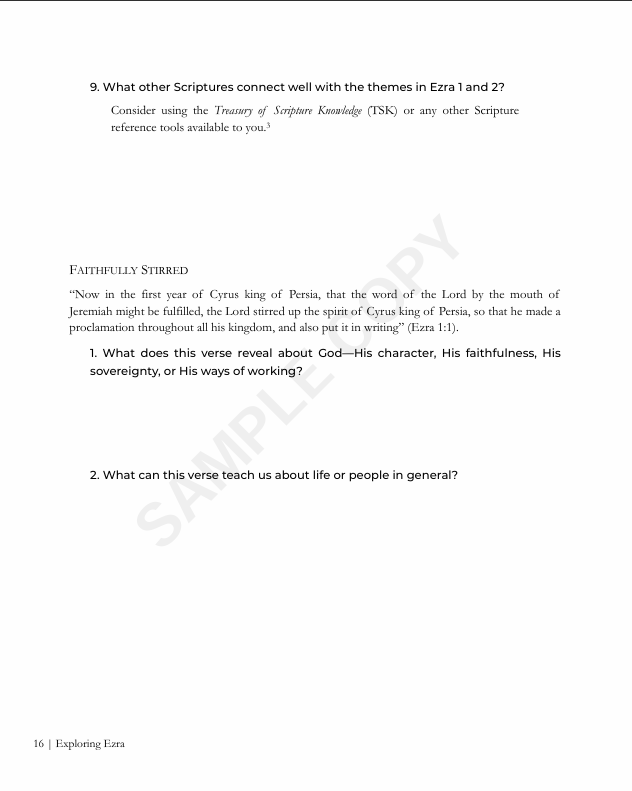
9. What other Scriptures connect well with the themes in Ezra 1 and 2?
Consider using the Treasury of Scripture Knowledge (TSK) or any other scriptural reference tools available to you.6
Faithfully Stirred
“Now in the first year of Cyrus king of Persia, that the word of the LORD by the mouth of Jeremiah might be fulfilled, the LORD stirred up the spirit of Cyrus king of Persia, so that he made a proclamation throughout all his kingdom, and also put it in writing” (Ezra 1:1).
1. What does this verse reveal about God—His character, His faithfulness, His sovereignty, or His ways of working?
2. What can this verse teach us about life or people in general?
3. What does this verse show you about yourself—your heart, tendencies, faith, etc.?
4. Does this verse offer you hope? Briefly share your thoughts.
5. How might you share the truth of this verse with someone who needs encouragement?
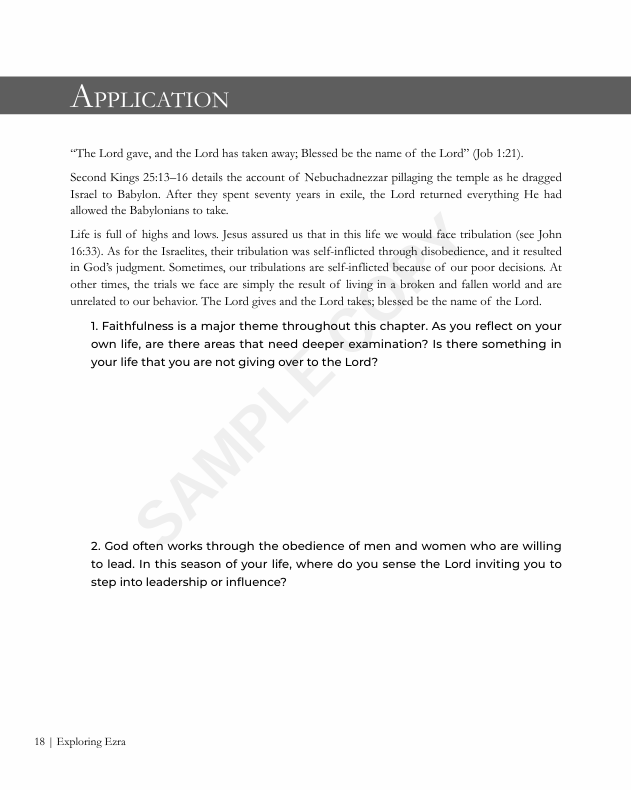
Application
“The Lord gave, and the Lord has taken away; Blessed be the name of the Lord” (Job 1:21b).
Second Kings 25:13–16 details the account of Nebuchadnezzar pillaging the temple as he dragged Israel to Babylon. After they spent seventy years in exile, the Lord returned everything He had allowed the Babylonians to take.
Life is full of highs and lows. Jesus assured us that in this life we would face tribulation (see John 16:33). As for the Israelites, their tribulation was self-inflicted through disobedience, and it resulted in God’s judgment. Sometimes, our tribulations are self-inflicted because of our poor decisions. At other times, the trials we face are simply the result of living in a broken and fallen world and are unrelated to our behavior. The Lord gives and the Lord takes; blessed be the name of the Lord.
1. Faithfulness is a major theme throughout this chapter. As you reflect on your own life, are there areas that need deeper examination? Is there something in your life that you are not giving over to the Lord?
2. God often works through the obedience of men and women who are willing to lead. In this season of your life, where do you sense the Lord inviting you to step into leadership or influence?
3. After seventy years in exile, some Israelites willingly forsook the comfort and familiarity they had established in Babylon to follow God’s call, while others chose to stay. Where is the Lord prompting you to step out into a place of deeper faith or obedience and out of your comfort zone?
Not that I speak in regard to need, for I have learned in whatever state I am, to be content: I know how to be abased, and I know how to abound. Everywhere and in all things I have learned both to be full and to be hungry, both to abound and to suffer need. I can do all things through Christ who strengthens me. (Philippians 4:11–13)
4. As you have walked through this chapter, what additional applications has the Holy Spirit brought to your attention?
NOTES
References
1 Flavius Josephus, The Antiquity of the Jews (Wilder, 2009), 416.
2 Josephus, The Antiquity of the Jews, 416.
3 Dwight J. Pentecost, Things to Come (Dunham, 1958), 244.
4 Flavius Josephus, The Antiquity of the Jews (Wilder, 2009), 417.
5 Warren Wiersbe, The Bible Exposition Commentary: Joshua–Esther (David C. Cook, 2003), 607.
6 The Treasury of Scripture Knowledge (Hendrickson Publishers, 1990). Also available at blueletterbible.org.