

Exploring Ezra Leader Notes
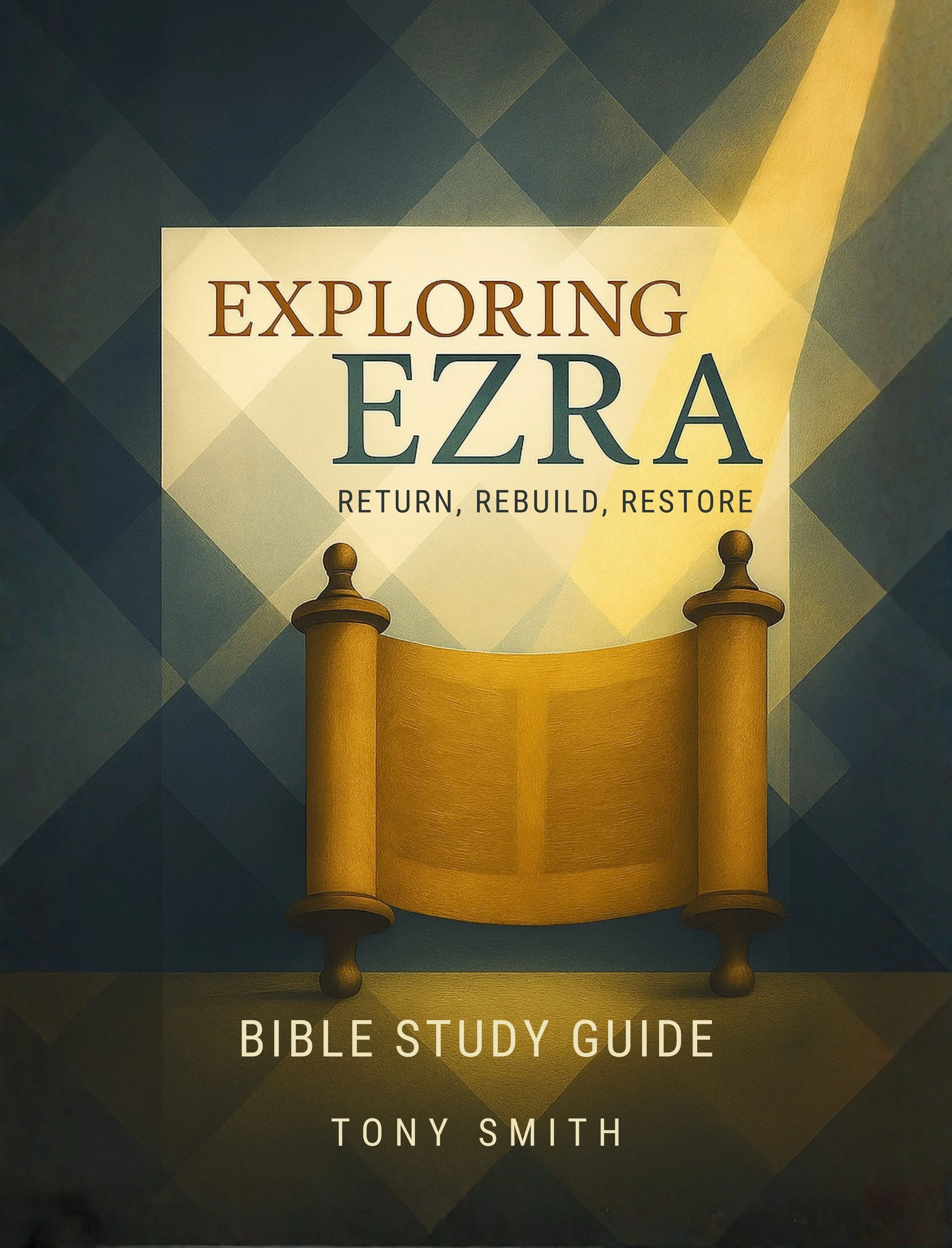
These Leader Notes accompany Exploring Ezra: Return, Rebuild, Restore. At my home church I taught 20–30 minutes from these notes, then the group breaks out and works through the study guide together — each member with a copy in hand, doing the observation, interpretation, and application themselves. You may adapt to whatever format works best for you.
The Leader Notes are free. The study guide is what each person works through. If you’re leading a group, preview the sample lesson to see what your members will be working through.
Exploring Ezra: Small Group Teaching Notes
Ezra 1–2: God’s Faithfulness to His Word
The Big Idea: God Is Faithful to His Word
The book of Ezra opens as a witness to God’s faithfulness. The events recorded here are the direct fulfillment of prophecy spoken through Jeremiah — God said it, and now He does it, precisely as promised.
Within that faithfulness, a secondary theme emerges: man is unfaithful. God keeps His word even when His people do not keep theirs.
See 2 Timothy 2:11–13
This tension, God’s faithfulness set against human unfaithfulness, runs through every chapter. Establish it clearly at the outset so the group feels the weight of it throughout the study.
A Note on Prophecy: Jeremiah vs. Daniel
Two prophets are often confused here — worth distinguishing from the start:
• Jeremiah pinpoints the length and timing of the exile — 70 years of captivity in Babylon
• Daniel pinpoints the length of time until the Messiah — the 70 weeks of Daniel 9
These are two distinct prophecies with two distinct purposes. Ezra is the fulfillment of Jeremiah’s. Daniel’s 70 weeks point forward to Christ.
Historical Setting (538–458 BC)
Cyrus the Great defeats the Babylonian Empire — the very empire that had carried Israel into captivity. What looks like a shift in world power is, from God’s vantage point, the precise fulfillment of His promise.
The Road to Exile — 2 Chronicles 36:15–21
Before the return can be understood, the exile must be felt. God sent prophets with warnings. His people mocked them, despised His words, and scoffed at His messengers until there was no remedy.
• This is the language of a hardened heart. Compare Pharaoh in Egypt: he hardened his heart until God solidified it for judgment. Israel did the same.
• The result: Nebuchadnezzar — called “My servant” by God (Jer. 25:9; 27:6; 43:10) — burns the house of God, destroys the walls of Jerusalem, and carries the people into exile.
• The articles of the temple are taken as spoils of war and housed in Babylon and held there until God is finished with Babylon and ready to act.
Contemporary Books
Ezra doesn’t stand alone. Situating it among its contemporaries helps the group see the full picture of this period:
• Narratives: Ezra, Nehemiah, Esther
• Prophets: Haggai, Zechariah, Malachi
• Daniel: both prophet and narrative — his story spans Babylonian rule into Persian rule
Ezra 1 — The Word of God Acts
v. 1 — In the Very First Year
The book opens in the first year of Cyrus king of Persia. This is not incidental. God raises Cyrus and fulfills His word immediately — not eventually, not partially, but precisely and on time.
All of Scripture is God-breathed and inspired. The book of Ezra is, among other things, a living demonstration of that truth.
How Did Cyrus Know?
Cyrus is a Gentile king, yet he knows the God of Israel, knows God’s will, and acknowledges God’s authority: “The LORD God of heaven has commanded me.” How?
• Daniel served as prime minister under both Babylonian and Persian rule
• It is widely held among commentators that Daniel introduced Cyrus to the Word of God — specifically through Isaiah 44–45, where God names Cyrus by name roughly 150 years before his birth
• Josephus records that Cyrus read these prophecies and was moved by them
Reference: Isaiah 44:28–45:1, 13
The word of God impacted Cyrus and provoked him to action. This is the pattern throughout Scripture and throughout this study: when God speaks, things move.
Note: The title “LORD God of Heaven” (v. 2) carries weight. The glory of God had departed from the temple in Ezekiel 8–11 — moving from above the cherubim, to the walls, to the city, to the Mount of Olives, waiting for repentance. God’s address has changed. He is the God of heaven now, not the God enthroned in Jerusalem — yet.
vv. 5–6 — The Spirit Moves Men
When the Spirit moves, He moves men to action. The return to Jerusalem is not a passive drift. It is a Spirit-prompted step of faith.
• Faith without works is a dead faith. These men stepped out in faith and led.
• Cyrus and the surrounding peoples provide resources for the journey. Chuck Smith used to say: “Where God guides, God provides.” Ezra 1 is the proof.
Reference: John 15:4–5
Abide in Me. Without Me you can do nothing. We gain our sustenance in Christ. We cannot be godly husbands, leaders, fathers, businessmen — anything — without Him. Nothing means nothing.
God Preserved the Temple Articles
The articles taken by Nebuchadnezzar were not lost — they were held in Babylon until God was ready. God permitted those with desire to return. Many stayed in Babylon. Why?
Reference: Jeremiah 27:21–22
Until God was ready.
Note: Those who stayed were not persecuted for remaining, but they were exposed to threats, as the book of Esther demonstrates.
Ezra 2 — Why the Genealogy Matters
Ezra 2 is a list of names. It can feel like the study’s first speed bump. It isn’t. Teach the group to ask: why does God preserve this list?
The Answer: Legitimacy and Order
The return to Jerusalem is not a mob, it is an ordered, covenant community. The list establishes who these people are and what roles they will fill:
• v. 2 — Led by Zerubbabel, a son of Shealtiel in the line of David. He appears in both genealogies of Christ and later becomes the Persian governor. Instrumental alongside the priest Jeshua.
• vv. 36–39 — Priests: necessary to resume the duties of the temple upon its completion
• v. 40 — Levites: required for their roles under Mosaic law
• v. 41 — Singers
• v. 42 — Gatekeepers
• vv. 43–54 — Nethinim: servants assigned to fulfill the menial tasks of the temple
• vv. 55–57 — Solomon’s servants: similar class to the Nethinim
• vv. 61–63 — Those without record: could not prove lineage, excluded from the priesthood until the matter could be settled
The Total
Just under 50,000 people — all in one accord, all moved by the Spirit, all ready and willing to do the Lord’s work and rebuild the temple.
A Word of Caution
They begin well, but it’s not how we start — it’s how we finish. The rest of the book of Ezra will test that.
Application: Make It Personal
Ezra 7:10 is the heartbeat of this study. Before the group leaves Session 1, make it personal:
“I will prepare my heart to seek the Law of the Lord, and to do it, and to teach statutes and ordinances in ________”
(my home, my ministry, my workplace, everywhere)
Commit it to memory. God’s faithfulness to His word in Ezra 1–2 is only compelling if we believe that same word is alive and active in our own lives today.
Key Question for the Group
How can you lean on the word of God if you’re not daily in the word of God?
The Apostles Had a Pattern.
So Can Your Group.
Free Guide For Bible Study Leaders
The early church had four marks of transformational fellowship drawn from Acts 2:42. This free guide unpacks them and shows you how to foster them in your own group.
Free. Immediate. No Strings.